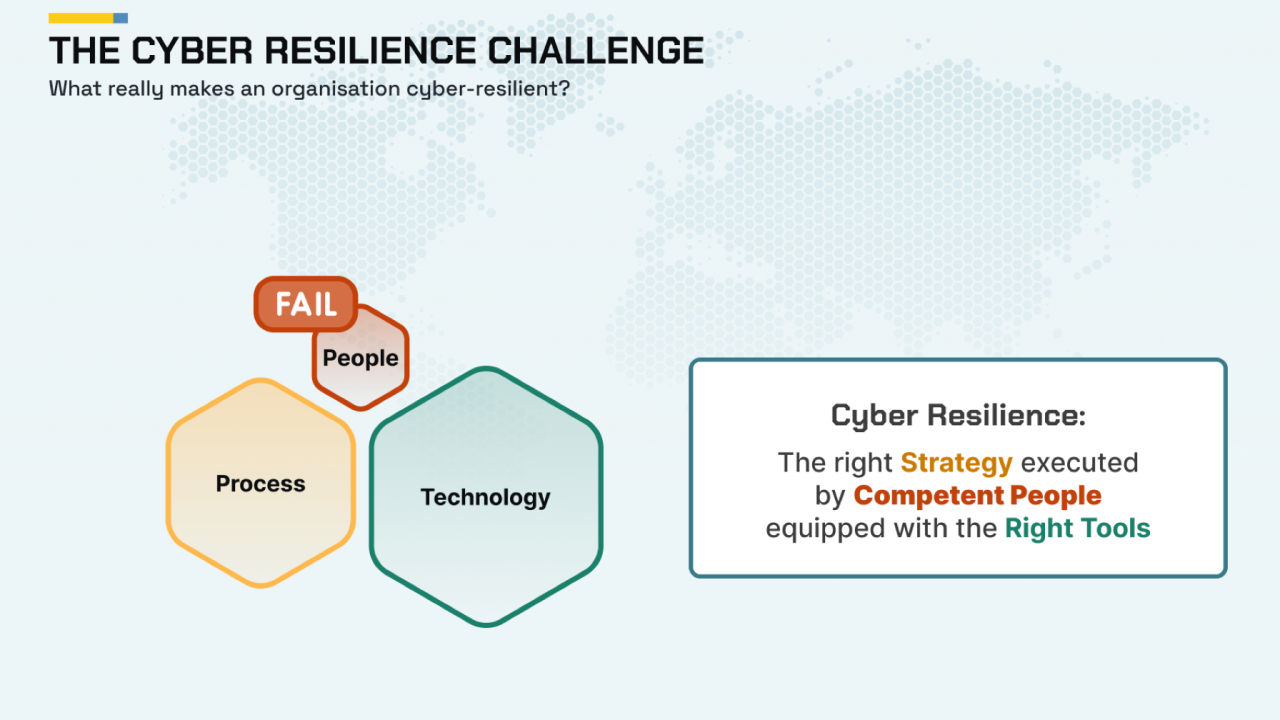
Resilience isn't a product. It's the ability of your organization to keep operating when bad things happen. In practice, it's Strategy × Process × People × Tools — under pressure.
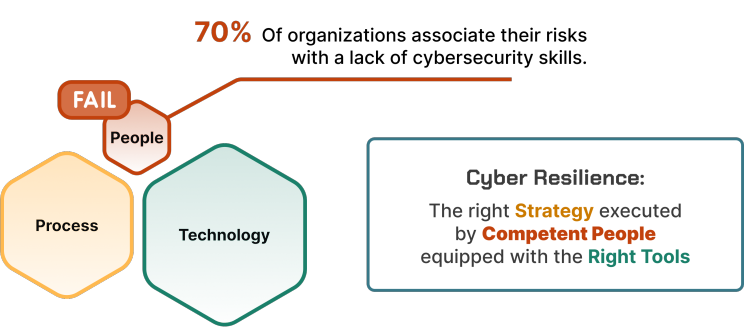
When execution improves, risk goes down and ROI shows up in MTTD/MTTR, patch SLAs, and validated playbooks.
How do you measure resilience?
Stop measuring “maturity.” Start measuring whether your teams can execute the right tasks, with your tools, under pressure.
Examples:
- SOC/CERT: Can the team detect, triage, contain, and recover within target MTTD/MTTR? Are playbooks followed under stress?
- Engineering & DevOps: Do teams ship secure code, remediate vulns within SLA, and harden infra as designed?
If execution breaks, resilience is theoretical. That's why resilience depends on cyber readiness at the job level.
What is Cyber Readiness (Job Readiness)?
It's the ability of an individual or team to perform role-specific tasks to standard, inside your processes, with your stack.
To make it measurable, you need:
1 - A shared market definition of roles, tasks, and skills. Use recognized frameworks to avoid reinventing the wheel:
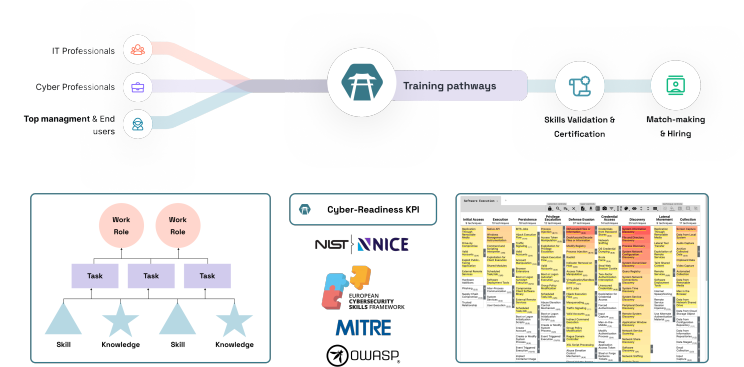
- NICE, DCWF, ECSF for cyber roles & competencies.
- MITRE ATT&CK / DEFEND / ATLAS / ICS to ground tasks in real adversary behaviors and defensive patterns.
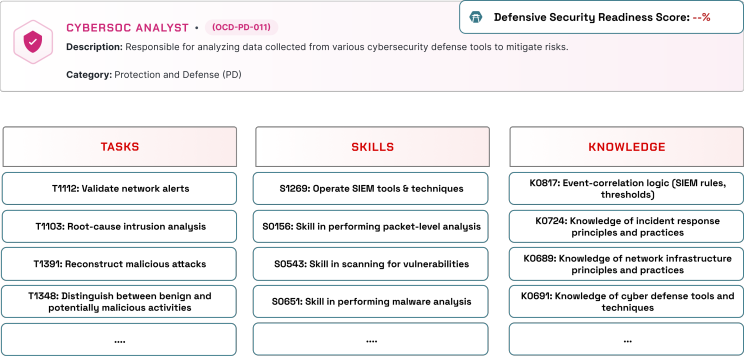
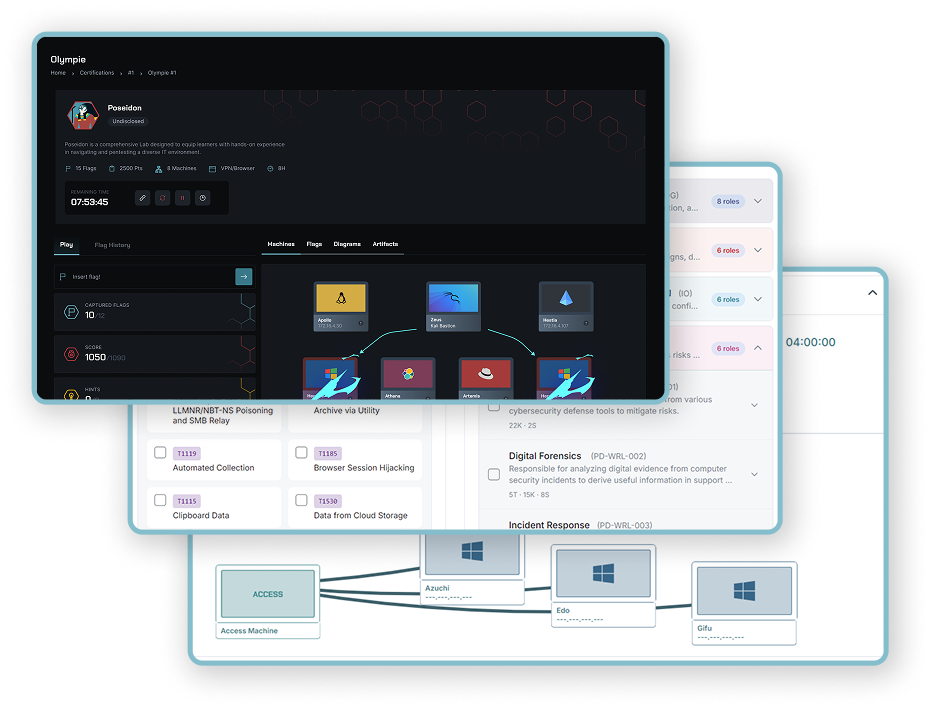
2 - Execution-based evaluation Tool : Use mission-based simulations/cyber ranges (not quizzes) that mirror real work, score execution, benchmark teams, and expose gaps.
Bonus: Transform your cyber-involved job descriptions into a task matrix mapped to NICE/ECSF/MITRE via an AI mapping tool. Then assign the exact missions that validate each task. (This is how we run it at SecDojo.)
The Readiness → Resilience Loop (run quarterly)
1. Assess. Baseline each role with hands-on missions (not quizzes). Capture metrics: task completion, error rate, time-to-detect/respond, patch latency, code security findings, playbook adherence.
2. Analyze. Identify capability gaps by role/team. Link them to risks (e.g., “insufficient lateral movement detection → material breach risk in flat segments”).
3. Upskill. Auto-generate learning paths mapped to NICE/MITRE tasks & knowledge areas. Assign, track, and enforce SLAs for skills uplift.
4. Re-validate. Re-run the same missions or harder variants to confirm remediation.
5. Report. Roll up into a C-suite dashboard: Readiness Score by function, MTTD/MTTR deltas, % critical playbooks validated, vuln SLA adherence, secure-coding pass rates, bench depth for key roles.
Two Modes of Measuring Readiness (use both)
1 - Asynchronous (self-paced missions)
- Individuals/teams complete assigned missions within a time window.
- Best for continuous assessment, hiring/benchmarking, and targeted upskilling.
- Scales globally and is ideal for distributed teams
2 - Synchronous (live-fire exercises & crisis sims)
- Real-time, multi-team operations with scoring, leaderboards, and command pressure
- Best for cross-functional readiness, communications, and incident-command validation.
- Produces board-ready evidence of operational preparedness.
Why CISOs care (and Boards listen)
A readiness program tied to business risk helps you:
- Quantify exposure reduction: convert playbook coverage, MTTD/MTTR deltas, and patch-SLA adherence into estimated loss-avoidance.
- Prove operational control: show validated detection & response against current TTPs (ATT&CK-aligned).
- Accelerate hiring & onboarding: assess candidates and new hires on the exact missions they'll perform.
- Defend the budget: readiness deltas + closed gaps → credible ROI narrative.
What “good” looks like (Example of targets many CISOs set)
- 20–40% faster MTTD, 30–50% faster MTTR after first two assessment cycles.
- 100% validation of high-risk playbooks (ransomware, BEC, cloud key compromise, OT lateral movement).
- Secure coding: % of engineers passing role-based secure-SDLC missions.
Putting it to work : Start with a 90-day loop:
- Define the roles & tasks you'll measure (NICE/MITRE anchored).
- Baseline asynchronous missions per role + one live-fire group exercise.
- Map gaps → role-based upskilling paths (auto-generated where possible).
- Re-test, report deltas, and lock a quarterly cadence.
Resilience is the outcome. Readiness is the operating system.
If you'd like to explore how to implement this approach in your organization, you can book a time here: https://calendly.com/secdojo/30min-call
Originally published in SecDojo Insights on LinkedIn.
View original publication